
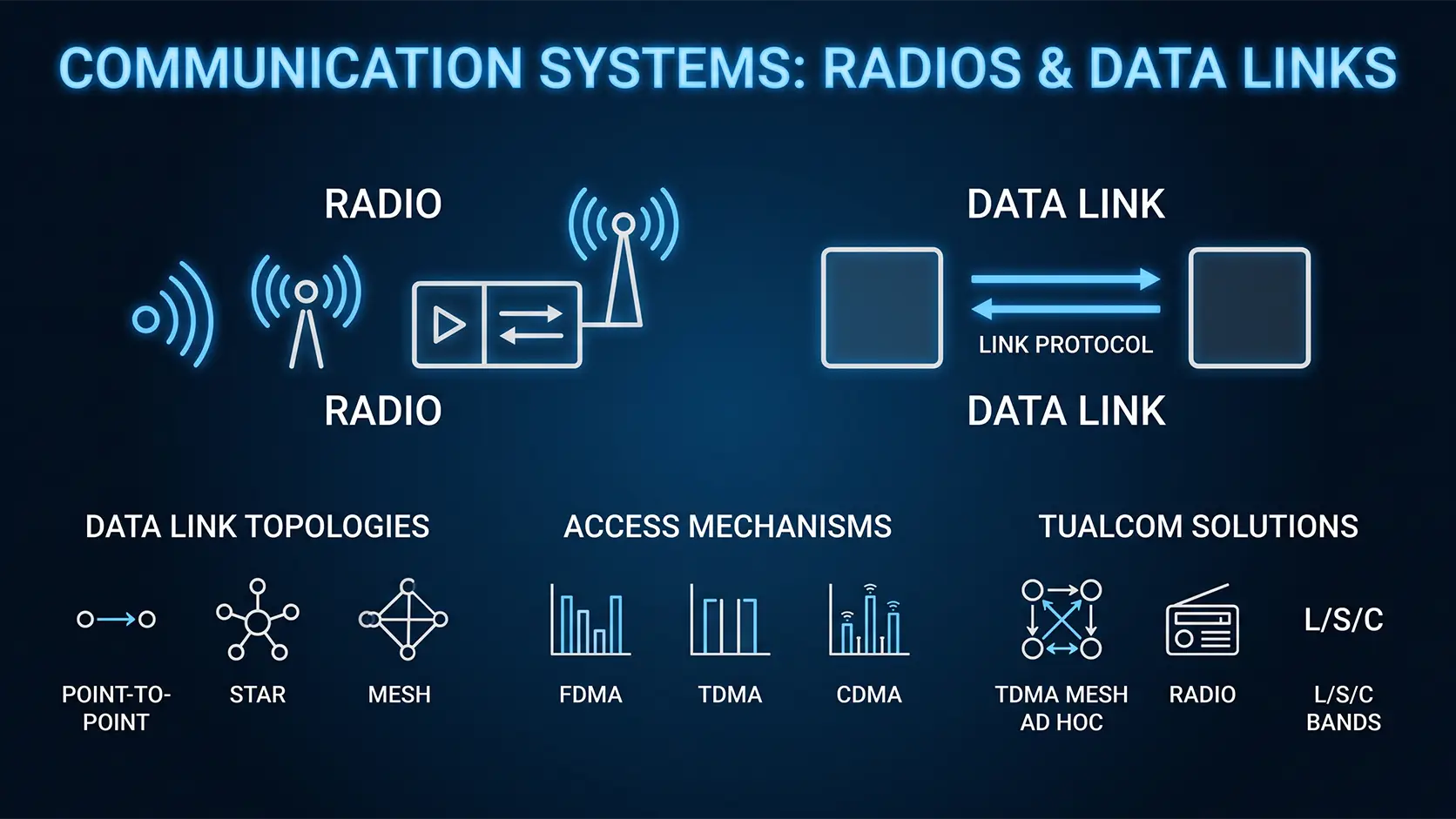
Radio is the technology of communication by means of electromagnetic waves. The electronic devices transmitting and receiving these waves and signals are also referred to as radio.
A data link is a set of electronics appliances, consisting of at least a transmitter and a receiver together with an interconnecting data communication circuit. These are governed by a set of communication rules referred to as link protocol, which enables digital data to be transferred between the communicating entities.
The most basic data-link configurations are as follows:
- Simplex communications, referring to the case where communications occur in only one direction,
- Half-duplex communications, referring to the case where communications occur in both directions, but not in both ways simultaneously,
- Duplex communications, referring to the case where communications occur in both directions simultaneously.
Data Link Topologies
Like all other networks, the topological structure is one of the primary characteristics of a data link. Here, physical topology refers to the placement of the data link components, while the logical topology illustrates the data flow. Distances between communicating devices, physical interconnections, transmission rates, signal and modulation types are other design factors.
- Point-to-point topology refers to the simplest communication between only two entities.
- Star topology refers to case where all the devices are connected to a single hub. This hub behaves as the central node and all other nodes are connected to the central node. If N devices are to be connected in a star topology, then the number of required connections is N. It is easy to set up, robust, all connections are independent from each other. On the other hand, the central node constitutes a single point of failure.
- Mesh topology refers to the case where every device is connected to another device via a particular channel. These channels are orchestrated dynamically, yielding fast, fault tolerant and reliable communications. Since participation and departure of each entity can occur at any time for a real network, mesh topology is usually accompanied by an Ad Hoc network structure.
Other network topologies such as Bus, Ring, Tree are usually not appropriate and applicable for data links due to physical constraints and limitations.
Data Link Access Mechanisms
There are three fundamental methods used to share a single communication channel among multiple users in an efficient manner without interference:
- FDMA (Frequency Division Multiple Access) is the mechanism for which the channel is divided into separate frequency bands for each communicating entity. It is originally proposed for analog communications, it lacks flexibility especially for the cases of data transmission requirements of each entity inside the network varies in time.
- TDMA (Time Division Multiple Access) is based on assignment of different time slots to each communicating entity at the same frequency. The number of time slots assigned to each communicating entity can be adjusted dynamically depending on the temporal needs of the relevant entity. Moreover, separation in time yields interference suppression. On the other hand, this technique requires time synchronization. Management of this technique requires expertise and skill.
- CDMA (Code Division Multiple Access) relies on utilization of unique codes to differentiate the entities sharing the same frequency band at the same time. It does not require time synchronization, but it is quite complex and is not quite scalable.
TUALCOM Communication Solutions
TUALCOM Data Link Solutions
TUALCOM provides TDMA Mesh Ad Hoc Data Link solutions operating in L, S and C Bands. With their compact sizes and low power consumptions, TUALCOM Data Link terminals are quite appropriate to be used in many platforms including mini, midi and tactical UAVs.
Incorporating SDR modems with advanced modulation techniques, spectrum utilization capability, AES-256 encryption, optional frequency hopping and direct sequence spread spectrum (FHSS or DSSS) are provided by TUALCOM Data Link devices. Establishment of self-healing and self-forming Ad Hoc mesh networks, manual or automatic data rate adjustment up to 10 Mbps via time slot reallocations are possible. For more information about the relevant solutions, technical details and probable use cases, please visit this Data Link Solutions.
TUALCOM Radio Solutions
Operating at S and C Bands, TUALRADIO family also has members featuring TDMA together with advanced modulation techniques, spectrum utilization capability, AES-256 encryption, frequency hopping and direct sequence spread spectrum (FHSS or DSSS) capabilities. Like all other TUALCOM products; compliance with harsh size, weight and power requirements yield a plethora of use cases and applications on various platforms for the TUALRADIO family.
